
Sector
Real estate brokerage
A 220-user brokerage with offices across the UAE. The client asked not to be named, so this is published anonymously. Everything else — the scale, the scope, the problems and the measured outcomes — is exactly as recorded in the project documentation.
Real estate brokerage
Multiple offices, UAE
220
2024 – 2025
Five problems, all of which will be familiar to anyone running a brokerage at this size.
Three criteria decided the platform: one unified system covering CRM, tasks and collaboration rather than three tools stitched together; communication built in, including telephony and instant messaging, so response time could actually be managed; and a hosting choice — cloud or on-premise — that satisfied the client's data-confidentiality requirements. Bitrix24 met all three.
CIS was selected on track record in this exact sector, a support team that would run training and onboarding rather than hand over a login, and a commitment to fast-track delivery of the portals followed immediately by team training.
Sales and customer support were deliberately sequenced first, so client management and response had one system before anything else moved.
Meta and Google Ads wired directly into the CRM alongside the property portals, so no enquiry depended on someone remembering to copy it across.
Calls placed and logged against the client record, which removed the gap between what was said and what was written down.
Dedicated groups per project for updates, document exchange and file organisation across departments and offices.
Ticket status and response tracking, so queries stopped disappearing into individual inboxes.
Custom import work to move historic records without losing integrity — the part of the project that took longest.
This is the part most CRM projects skip, and it is the part that decided this one. Workshops were run per department, covering only the features that department would actually touch. User manuals were written and Q&A sessions hosted. An internal help desk was set up inside Bitrix24 so questions had somewhere to go after go-live.
Senior management used the system themselves for project oversight and performance tracking. That mattered more than any training session: when leadership works in the tool, adoption stops being optional.
Two things went wrong and are worth stating. Customisation ran longer than planned because the legacy data structures were more complex than they first appeared — resolved by working directly with the client's IT team. And some users resisted the change, which we addressed with feedback loops and tailored training rather than mandate.
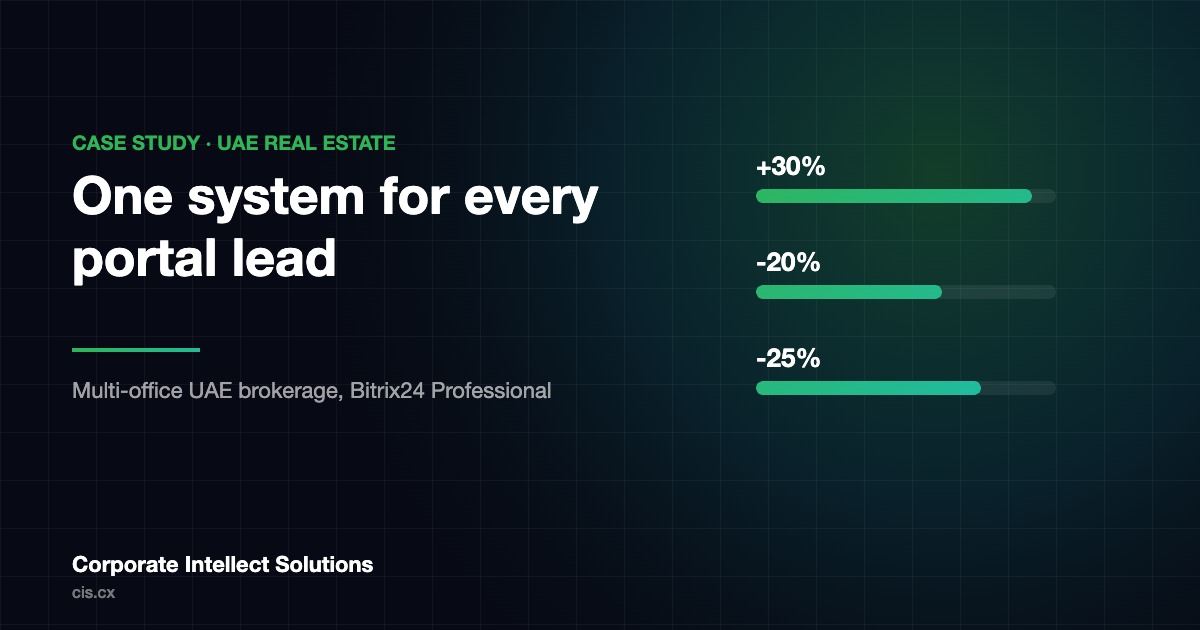
+30%
Management decisions in key departments were reached around 30% faster once current pipeline and client data was available on demand rather than requested from another team.
−20%
Roughly 20% of the time previously spent manually chasing task status across departments and offices was eliminated once progress was visible in Bitrix24.
−25%
Document collaboration time fell about 25%, with tenancy contracts and sale-purchase agreements prepared, shared and tracked in one place instead of email threads.
Alongside the numbers: stronger inter-departmental working, and higher reported employee satisfaction as manual work fell away. The client's own summary emphasised communication, productivity and a more cohesive team — and singled out the step-by-step approach to integration rather than a single cutover.
If the problems above describe your operation, the fix is not a bigger spreadsheet. We will map your portals, your pipeline and your agent structure, and tell you honestly what six to ten weeks would deliver.